The Los Burros Mining District and the Lost Town of Manchester
Organized 1876, transformed by Willey Cruikshank's Last Chance strike in 1887 — and gone by 1897, burned and grown over. The rise and fall of the coast's gold district, and the lost town of Manchester.
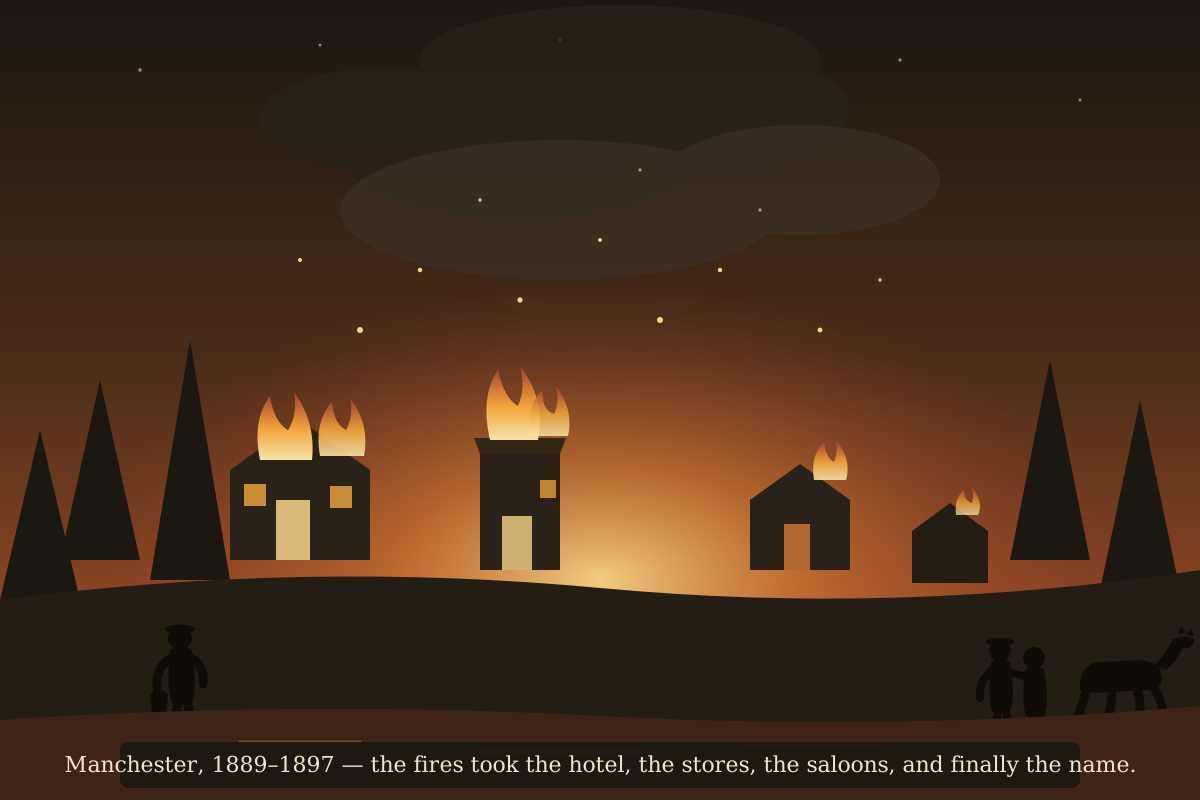

The Santa Lucias kept their gold a long time. When they let it go, they did it all at once — and for eight years there was a town in these mountains where there is now nothing but brush.
The district
The Los Burros Mining District was organized in 1876, and for a decade it amounted to little: placer men working the creeks — Willow Creek, Alder Creek, Plaskett Creek and their tributaries — panning color out of gravel and dreaming. Chinese placer miners had been in Salmon Creek even earlier, before 1875 — the coast’s first prospectors.
Then, on March 24, 1887, William D. “Willey” Cruikshank struck quartz on the ridge and named his find the Last Chance. It was the first truly paying mine on the coast, and it changed everything. Willey and his partner Jim Krenkel worked it until later that year, when they sold to seven investors who renamed it the Buclimo — from their own initials: BUrman, ULrich, CLinton, LInderman, Isenman, MOrey, OLsen. The Last Chance shipped an estimated $62,000 in gold ore — real money in 1890.
Manchester
Almost overnight, a town: Manchester, at the head of Alder Creek a few hundred yards downhill from the Last Chance itself — about four miles inland of Cape San Martin, up the grade from Willow Creek, where most of the district’s placer gold came out of the gravel. Its population ran somewhere between 125 and 350, depending on who counted and when. It had a hotel, two general stores, a barber shop, a restaurant, a blacksmith, a one-room school, mess halls, bunkhouses, a scatter of cabins, a small cemetery — and, as Mabel Plaskett wrote, “of course saloons, and many are the tales of the rioting and violence in the short life of the town.”
The post office opened September 14, 1889. Mabel preserves a detail the official records lose: the mining-district post office was first called Mansfield, with Pete Gillis as postmaster, and only later renamed Manchester. A school district named Mansfield stood at “Lonny Field” on the old mail trail — where Lonny Plaskett’s children went to school.
Then it was over. Most mining ceased by about 1895, and a series of fires between 1889 and 1897 took every building. The lost city of the Santa Lucias burned down and grew over. What survives is a handful of photographs — and this family kept some of them.
The Plasketts in the district
The Plasketts were Pacific Valley people, a few ridges west, but they had their hands in Los Burros from the start:
- Leonidas “Lonnie” Plaskett held the family’s district interests. The Plaskett Bros. Mining Company claims — the Ocean View, the Lilac, and the Blackberry — passed to L.M. Plaskett in 1912, and the family credited those workings with close to $100,000 in gold.
- Reason and Marion Plaskett discovered the Western Star on Plaskett Ridge, hauling ore by mule sled down to the water-powered arrastra their father William Lucas Plaskett built on Plaskett Creek about 1885 — the same kind of machine as the Grizzly Mine’s wheel photographed below.
- Dudley Plaskett, Byron’s son, picked solid gold nuggets out of the mouth of Plaskett Creek in May 1911 and followed them upstream to a landslide.
- Lawson and Ed Plaskett, when drinking, would sometimes hint that they were on the verge of being rich men — gold or jade, any day now. Time proved their optimism to be the common dream of every young man on this coast.
The families were woven through it all. Willey Cruikshank courted and lost, recovered a dead man from a shaft no one else would enter, and vanished into these mountains in 1937. Jim Krenkel brought his bride Margaret to Los Burros in 1902 — she rode a mule named Gabe to her own wedding and dug the family well fifty feet by hand. Henry Melville came for the gold and stayed to become a legend of strength. And the mail trail from Gorda to Jolon ran right through the diggings: Byron Plaskett passed the Melvilles and the Krenkels on so exact a schedule that they set their watches by him.
The people of Los Burros
A mining district is not holes in a hill; it is the people who came for them. Manchester was a community — families, feuds, weddings, funerals, a school, a cemetery — and it did not simply vanish when the buildings burned. Its descendants are all over this coast and this state today. These are the names the family archive keeps. If one of them is yours, we would love to hear from you.
The strike and the mine
- William D. “Willey” Cruikshank (1862–1937) — found the Last Chance on March 24, 1887 and set the whole thing in motion. Watched Chinese placer miners on Salmon Creek as a boy and swore he’d find a bonanza. Engaged twice, married never; went down a shaft no one else would enter to bring up a dead man; walked into the mountains in 1937 and wasn’t found for six years.
- William Cruikshank Sr. (b. 1835) — Willey’s father, who brought the family from Calaveras County to Villa Creek in the early 1870s and kept the district’s first mining records, dating from 1875.
- James M. Krenkel (1862–1943) — Willey’s partner in the Last Chance, and one of the seven-way sale to the Buclimo Corporation in 1887.
- Margaret Voss Krenkel (1874–1964) — “Mother Krenkel,” the coast legend. City born and bred, born “in a house among the sand dunes near the Barbary Coast,” she rode a mule named Gabe to her own wedding in 1902, dug the family well’s first fifty feet by hand with her sister Lottie, cooked for harvest crews at $10 a month, and became the district’s practical nurse. Mabel called her the real-life “Hannah” of Lillian Bos Ross’s novel The Stranger.
- Henry Melville — came for the Los Burros gold and stayed a legend of strength: threw two robbers out of his own cabin, and lifted a wood-loaded wagon bare-handed so his son could grease the wheel. His mining company office is photographed below.
The Plasketts in the district
- Leonidas “Lonnie” Plaskett — held the family’s claims; the Ocean View, Lilac and Blackberry passed to him in
- His children went to school at Lonny Field, on the old mail trail.
- Reason and Marion Plaskett — found the Western Star on Plaskett Ridge and hauled ore by mule sled to their father’s arrastra.
- William Lucas Plaskett — built that water-powered arrastra about 1885.
- Dudley Plaskett — picked nuggets out of the mouth of Plaskett Creek in May 1911.
- Byron Plaskett — carried the mail through the diggings so punctually the Melvilles set their watches by him; his sons Ed and Lawson rode the route after him and talked, when drinking, of the riches always just ahead.
The neighbors, the characters, the rest of the community
The Los Burros country also holds Alvis Davis, whose saloon is photographed below; Ed Dutton, the Jolon constable who kept a broken skillet among his relics; Alice Dutton, Willey’s first fiancée; Augusta Stringle, his second, who married his cousin John D. Cruikshank instead; Henry Kilsdonk, whose mail bag hung on the trail; Linwood and Roy Mitchell, who brought Luther Burbank’s cuttings to the coast and whose family still held land at the head of Wild Cattle Creek; Joe and Dave Moro, the Jolon Indian brothers whose horse pasture near Chalk Peak still carries Dave’s name; Sam Pugh and Clay Dodge, who took the other two mills landed at Point Gorda in 1886; and the seven Buclimo partners themselves — Burman, Ulrich, Clinton, Linderman, Isenman, Morey and Olsen — who bought a mountain sight unseen and left their initials on it.
See everyone the archive records at Manchester →
Nothing is left of Manchester now but a marker, some level ground, and these pictures. The gold is still up there, in trace — and every so often somebody stubborn goes looking.


