The Schoolteacher Brides of Pacific Valley
The county kept sending young women to teach the coast's children — and the Plaskett boys kept marrying them. How two brothers married two sisters, and the schoolhouse became the town.
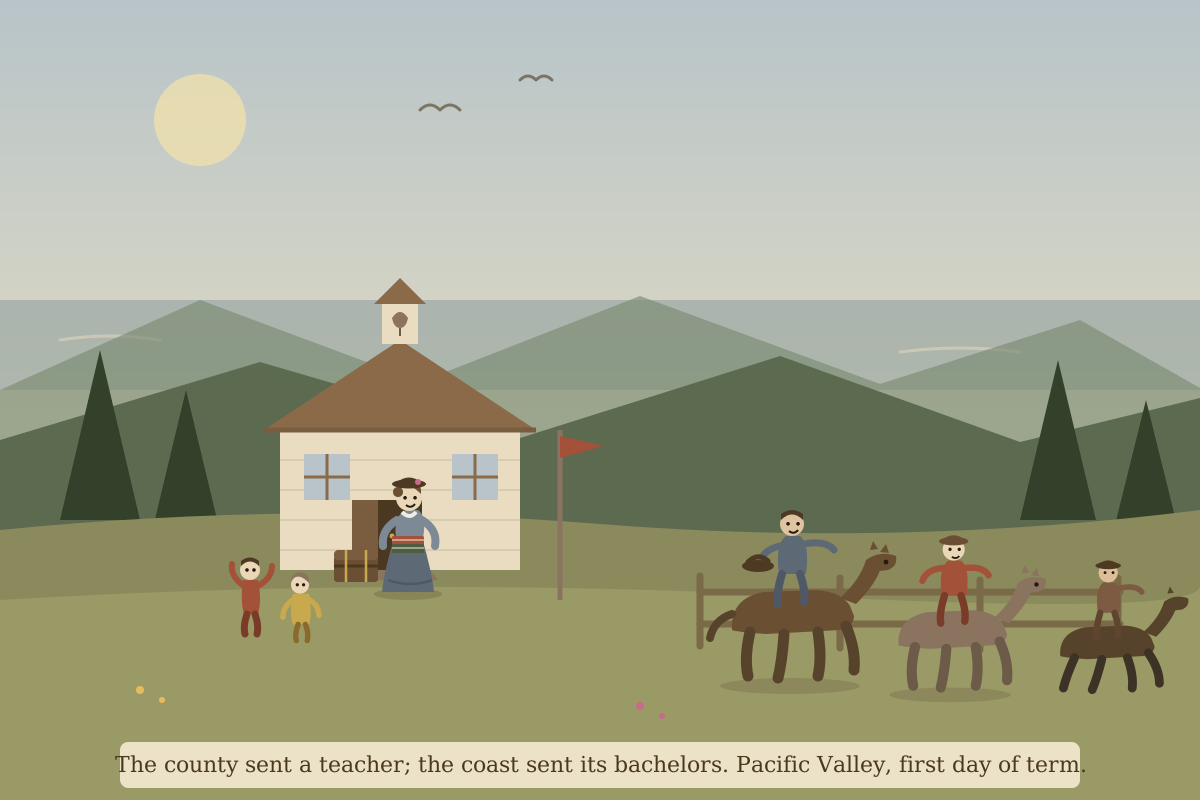

Isolation is a problem with many faces. On the Big Sur coast in the settlement years, one of them was arithmetic: the valleys were full of Plaskett sons and short of anyone for them to marry.
The government solved it, without meaning to, by sending schoolteachers.
The teacher arrives
A coast school needed a teacher, and a teacher was almost always a young unmarried woman from town. She came by train to King City, by stage to Jolon, and then — as Esther Smith found in 1913 — she was met by a man she had never laid eyes on, who put her luggage in a spring wagon and drove twenty-five miles across roadless country until dark, when they stopped for the night in a cave with ash a foot deep on the floor from generations of Indian fires.
“I curled up in one corner and listened all night to the scurrying sounds of small wild animals but I didn’t say a word. I’d made up my mind not to be afraid.”
In the morning they left the wagon in the cave, took the saddles stored there, and rode the rest of the way on horseback. She had never been much on a horse. The man with the wagon was Wilbur Harlan — her future father-in-law.
That was the coast’s marriage machine, and it ran for fifty years. Every term brought a young woman of some education into a country of young men who had none of her kind for a hundred miles. The community got a school. The school got a teacher. The teacher, more often than not, got married and stopped teaching — and the county sent another one.
The Plaskett boys and their teachers
Mabel Plaskett’s own history of the coast schools reads, in places, like a courtship register:
- Jenny Bush — taught Pacific Valley; married Dudley Plaskett.
- Lena Fuller — taught Pacific Valley; married Marion Plaskett.
- Nina Berger — taught the Mansfield School in the Los Burros hills in 1902 and Pacific Valley in 1893; married Albert “Allie” Plaskett. The Allie Plasketts homesteaded on Willow Creek flat, and their son Clarence remembered Jess and Roy Plaskett tossing him in the air while his mother taught school.
- Edith Place — taught Pacific Valley, and in Mabel’s wonderfully dry parenthesis, “almost married Billy Plaskett.”
It went the other direction too: Alan McLean, who taught at Argyle School near Jolon, married Olive Plaskett — William Lucas’s daughter — and became county auditor in Salinas. And on the Harlan side of the coast, two brothers married two teachers: George Harlan married Esther Smith (three years after the cave), and Paul Harlan married Alice Stewart, who had taught Redwood School in 1916. Esther taught for more than forty years; her sisters Marion and Ada Smith both taught Redwood too — three teaching sisters on one coast. Down at Mill Creek, the teacher Mrs. Mulcahy became Mrs. Charley Sans; Bertha Janes married Aniceto Lopez and kept right on teaching at Redwood and Mansfield both.
Two brothers, two sisters
And then there is the marriage at the center of this family.
Edward Abbott Plaskett (born 1881) and Lawson McKern Plaskett (born 1883) were brothers — the sons of Byron Gianavil Plaskett and Martha Bennett.
Mabel Eva Sans (born 1896) and Olive Hyacinth Sans (born 1898) were sisters — the daughters of Edward R. Sans, the sawmill man of Mill Creek known up and down the coast as the “Coyote Man,” and Lydia Rich.
Ed married Mabel. Lawson married Olive.
Two Plaskett brothers married two Sans sisters — which is why this family has double first cousins: children who share all four grandparents, as genetically close as half-siblings. On a coast this size, the family tree doesn’t branch so much as braid.
Both marriages carry the coast’s whole character in them. Mabel was fifteen when Ed — twice her age — proposed from a buckboard on the way to school, and she went on to become the chronicler who wrote everything you are reading. Olive married Lawson at fifteen too, bore eight children, and died at thirty-seven running out to turn the horses back into the corral. Mabel wrote two elegies for her sister.
The school was the town
The schoolhouse was never only a schoolhouse. “The Redwood School was the center of the community in those days,” Esther Harlan said — and it was true of every one of them: Redwood, Mansfield up at Lonny Field, Mill Creek, the emergency school at the Wild Cattle Creek road camp in 1933, and Pacific Valley, which the Plasketts’ valley has kept going since 1880 on the east side of the highway at Plaskett Creek.
Bill “Bull Plaskett” Alderson remembers the old one, before the new building went up:
“It was a very small school, very cramped — it was like a little house. But it was a gathering area for everyone in the community. There were all kinds of little social events there. I was probably five years old, marveling at this social connection area — and that was so important to the community.”
That is what the county was really shipping in on the Jolon stage: not just lessons, but the center of the town. The teacher opened the school, the school gathered the coast, the coast married the teacher — and the county, obligingly, sent another one.
Recorded in part from the memory of Bill “Bull Plaskett” Alderson, 2026. Read Mabel’s full histories: History of Coast Schools and History of Coast Schools Concluded.
A note on the record: family memory holds that the two Sans sisters were themselves schoolteachers. The archive doesn’t bear that out — Mabel was the coast’s writer, and Olive married at fifteen — so the schoolteacher brides and the two-brothers-two-sisters marriage appear to be two true threads of the same story that time has braided together. If you know otherwise, the family would like to hear from you.